Subscribe & get the latest news in your email

By
June 15, 2026
Do you know what your electricity actually cost, hour by hour, last week? Not the number on the monthly bill. The real, day-ahead and live wholesale price. If you actually look at it, you'll be surprised.
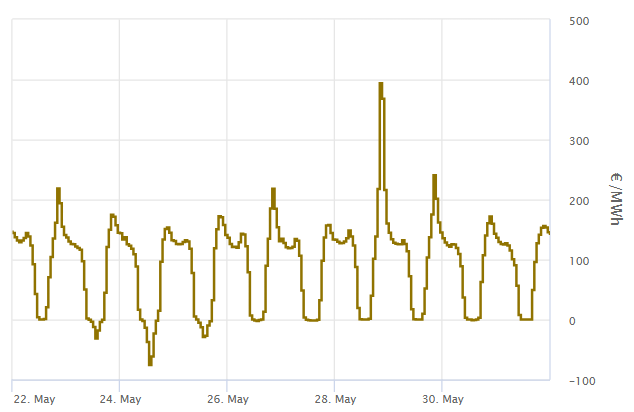
Look at the rhythm. Day-ahead market prices peak in the morning and evening at €150–200/MWh, then fall in the middle of the day. Down to zero every day. And on a couple of days even below it. The pattern repeats day after day.
The midday collapse is solar. When the sun is up, the grid fills with renewable power. Supply overwhelms demand, and the price drops. Literally every day electricity is (almost) free around midday.
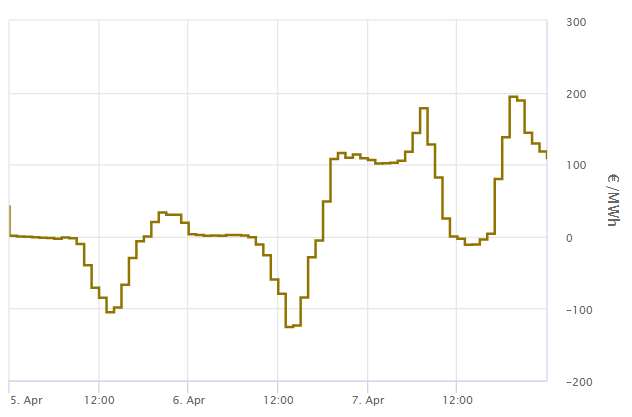
Now look at what happened in Germany over Easter 2026. The price didn't just touch zero. It went deeply negative, hour after hour across the holiday weekend, bottoming around −€130/MWh. A negative price means exactly what it sounds like: the market is paying consumers to take electricity off its hands. On the intraday market it was even more extreme: the price hit -€324/MWh at 15:00.
Day-ahead market vs. intraday market:
Why so extreme negative prices? Factories and offices were closed for the holiday, so demand cratered. The weather was sunny, so solar surged. With far more power than the grid could absorb, producers would rather pay you to consume than shut their plants down. A fleet charging that weekend wasn't just fuelling for free. It was getting paid to fuel up.
Negative prices are more common than you might think. In 2025, Germany had negative prices on the day-ahead market in 573 out of a total of 8,760 hours. That's 6.5% of the year - and 25% more than in 2024, so the trend is clear.
The grid literally pays people to use its electricity during 6.5% of the year.
Dr.-Ing. Jonas Schlund, CPO at Ampcontrol
A fleet's energy need is fixed. Every vehicle requires a set number of kWh to run its routes. But when that energy is delivered is flexible. Vehicles idle for predictable windows overnight and between shifts.
That flexibility is the entire opportunity. Plug in at 6pm and charge at full power, and you're buying at the top of the curve. Park that same charging in the midday or overnight trough, and you're buying at the bottom. Or you're even getting paid for fueling. Same energy. Wildly different cost.
"But I can't charge my trucks midday - they're on-route"! We hear that a lot. Well, there's a simple solution. Add battery energy storage (BESS) to your depot. It charges during the cheap hours, then feeds your trucks whenever they're back. Our TCO analyses consistently show that the economic benefit of BESS is even larger than adding solar panels. You can run your own truck TCO analysis with our free tool here.
The cheap energy is already on the grid. It shows up almost every day, in broad daylight. On some days, the grid will pay you to take it.
.jpg)
Ampcontrol is a cloud-based software that seamlessly connects to charging networks, vehicles, fleet systems, and other software systems. No hardware needed, just a one-time integration.