Subscribe & get the latest news in your email

By
March 4, 2026
When a fleet depot adds EV charging, it almost always triggers a bigger conversation about energy capacity. Chargers draw a lot of power. Utilities don't love spikes. Demand charges get expensive.
The typical response? Add a battery. Maybe add solar on the roof. Then hire someone to integrate it all. Or buy a separate energy management system on top of the charging software.
Suddenly you've got three vendors, two dashboards, and a system integrator in the middle trying to make them talk to each other. That's expensive, slow, and fragile.
Here's a pattern we see constantly: a fleet operator runs an RFP for a Charging Management System (CMS). Six months later, their energy team runs a separate RFP for an Energy Management System (EMS). Two vendors win. Then everyone spends a year trying to get them to talk to each other.
Nobody asked the most important question upfront: who coordinates between the two?
The answer can't be "a system integrator in the middle." Not if you want the system to actually optimize in real time.
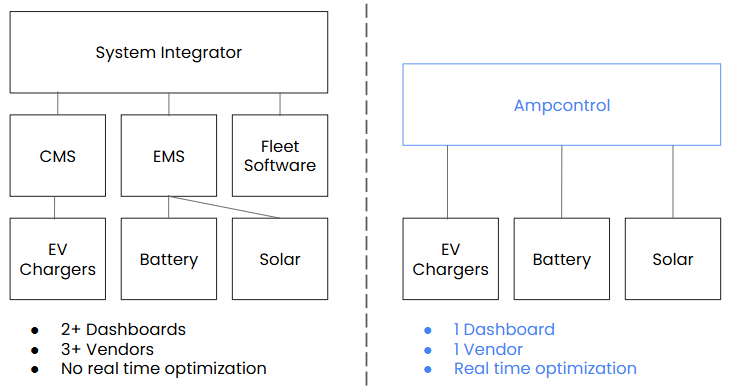
The battery doesn't know when the trucks are returning. The chargers don't know today's energy availability. The route planning software doesn't know the grid is about to send a curtailment signal.
But energy costs and operational efficiency are determined by exactly that intersection. The overlap between fleet schedules, charging decisions, and on-site energy assets.
The depots that will operate most efficiently over the next decade are the ones that stopped treating EMS and CMS as separate problems.
Dr.-Ing. Jonas Schlund, CPO at Ampcontrol
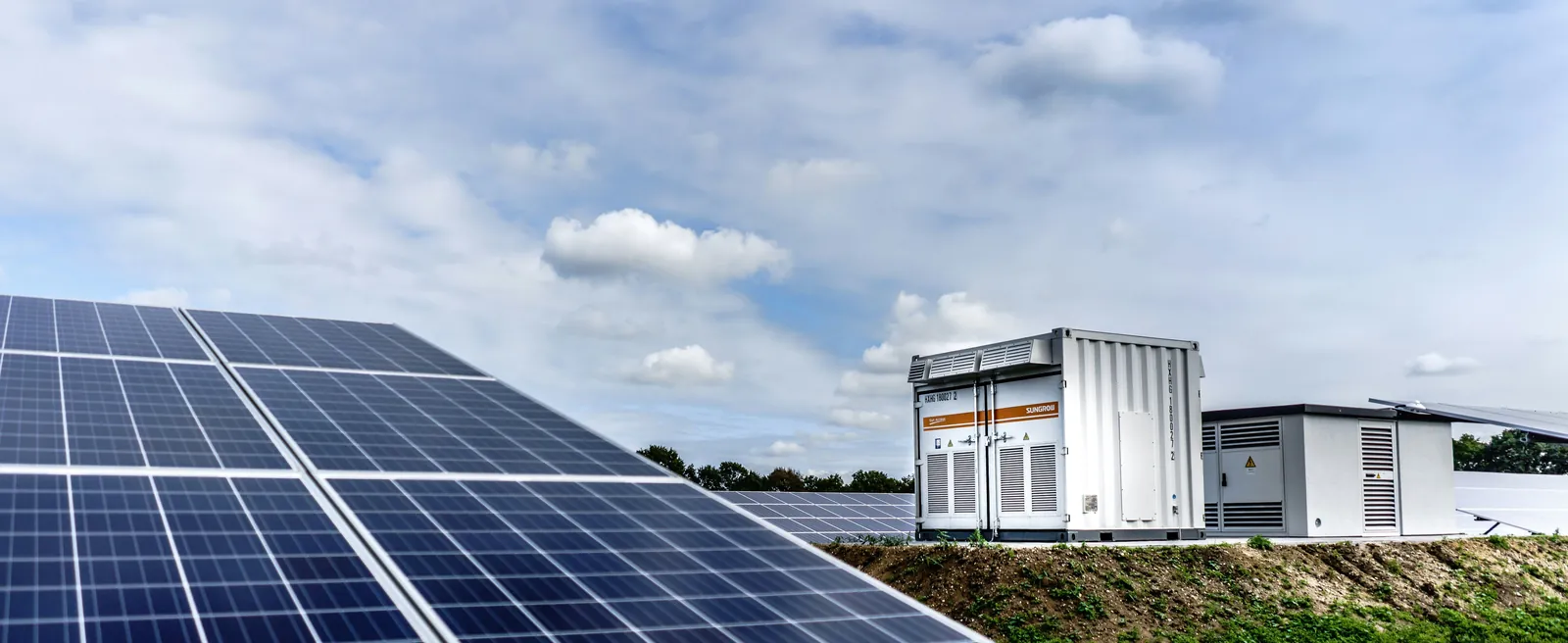
Ampcontrol manages, optimizes and controls EV chargers, battery storage and solar inverters from a single platform. The same system that's operating chargers reliably and scheduling fleet charging is also:
Ampcontrol uses OCPP for EV chargers and Modbus or MQTT for batteries and solar inverters with the AmpEdge as a local controller. Open, interoperable protocols that work with any hardware. No proprietary lock-in, no crazy custom integration projects.
The result: one reliable platform managing the entire charge point operation AND on-site energy stack with fleet schedule data feeding directly into charging and dispatch decisions.
This is part of a series on how Ampcontrol manages the full energy stack at fleet depots:
.jpg)
Ampcontrol is a cloud-based software that seamlessly connects to charging networks, vehicles, fleet systems, and other software systems. No hardware needed, just a one-time integration.