Subscribe & get the latest news in your email

By
March 13, 2026
The queue for a new grid connection used to be a formality. Today, in some of the world's most developed economies, it's a multi-year barrier or an outright impossibility. Flexible interconnection is the industry's answer. Here's what's working, what isn't, and what the US can learn from Europe and Australia.
Grid infrastructure was never designed for what we're asking of it today. Decades-old distribution networks are being asked to absorb millions of EV chargers, rooftop solar panels, heat pumps, and commercial loads, often all at once.
The traditional solution is to build more grid. Run new cables. Upgrade substations. That takes 5 to 10 years and costs billions.
Meanwhile, the electrification transition can't pause. Electric trucks, busses and charging infrastructure are ready and available. The total cost of ownership of going electric is already breaking even with diesel or gasoline in some countries.
Globally, fleets are ready to invest in future-proof assets but are blocked by congested power grids. But waiting years to get sites live or paying for grid upgrades in not an option.
Flexible interconnection offers a different deal: connect faster and cheaper today, in exchange for accepting dynamic limits on how much power you can draw (or export) at times of grid stress. The customer gains access. The grid operator gains a lever it can pull when the system is under pressure. Everybody wins, as long as the limits are predictable, enforceable, and fair.
That's the theory. The execution varies enormously by country. And the differences are instructive.
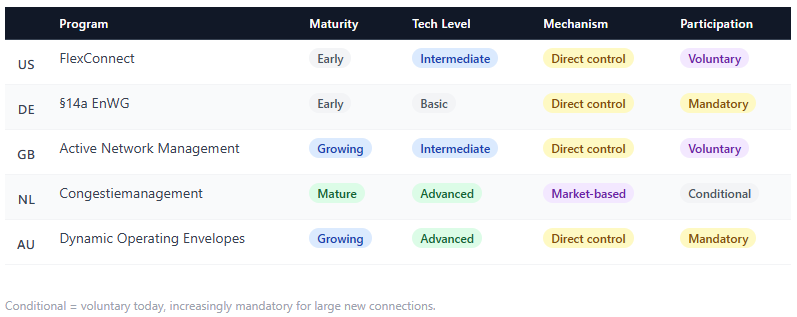
Let's take deeper dive into the 5 leading programs from the US, Germany, UK, Netherlands and Australia.
Live since 2023
FlexConnect is the most visible flexible interconnection program in the US. Under FlexConnect, commercial and industrial customers (fleet depots, logistics facilities, transit agencies) can receive a grid connection faster and at lower cost than a standard interconnection, in exchange for accepting dynamic load limits delivered via the IEEE 2030.5 CSIP protocol.
Limits can change on a day-ahead or real-time basis. Non-compliance risks curtailment of the entire connection.
What makes FlexConnect noteworthy is its protocol specificity. IEEE 2030.5 CSIP is a mature, cyber-secure standard designed for utility-to-customer communication. By mandating it, PG&E created a clear technical bar that energy management systems need to meet.
The bottleneck in fleet electrification isn't the hardware. It's software interoperability.
Dr.-Ing. Jonas Schlund, CPO at Ampcontrol on achieving IEEE 2030.5 CSIP certification
The limitation of FlexConnect is its geography: it's a single utility's program. A fleet operator with depots across multiple states still faces fragmented frameworks today. But PG&E has historically set precedents that other US utilities follow.
Live since 2024
Germany took a fundamentally different approach: it made flexible interconnection the law. §14a of the Energy Industry Act requires every distribution system operator (DSO) to offer reduced grid fees to customers who allow controllable loads above 4.2 kW to be curtailed during grid stress events. This isn't opt-in. Every qualifying asset on low-voltage connections in Germany is subject to this framework. For last-mile van fleets connecting at low voltage, §14a is real and relevant.
The advantage of a legislative mandate is standardization: every German DSO operates under the same rules, which dramatically simplifies the compliance burden for national operators. The limitation is that the law defines curtailment logic centrally rather than allowing local grid conditions to drive more individualized responses.
Large fleet depots (trucks or busses charging at 150 kW and above) almost universally connect at medium voltage putting them outside §14a's scope. Where Germany's framework does bite for larger depots is on the generation side. Under VDE-AR-N 4110, any site with solar or storage above 135 kW at medium voltage requires a certified EZA-Regler (Parkregler). The EZA-Regler is a grid connection controller that executes the DSO's active and reactive power setpoints in real time.
The practical implication is that the EZA-Regler and the energy management system need to operate in coordination. If the DSO curtails solar export while the charging system is optimizing against self-consumption assumptions, the two systems work against each other. A unified energy management layer like Ampcontrol prevents that conflict.
Live since 2023
The UK's approach to flexible interconnection operates through a combination of Active Network Management (ANM) schemes run by DSOs. They are connection agreements that trade curtailment risk for faster and cheaper access to the grid, very similar to FlexConnect. DSOs can remotely manage power flow and adjust capacity to remain within safe operating parameters.
For depot-based commercial fleets that charge overnight, DSOs can offer different import capacities at different times. This unlocks larger capacity overnight when network demand is low, while constraining daytime draw. This approach is analogous to what FlexConnect does in the US, though delivered through bilateral DSO agreements rather than a standardized protocol.
ANM has been around longer, but the commercial stakes changed significantly in April 2023, when Office of Gas and Electricity Markets (Ofgem)'s reform removed upstream reinforcement costs from demand customers. DSOs now largely fund grid reinforcement required for new demand connections, which has dramatically reduced project costs for many operators. Fleet News reported a commercial fleet's case, where connection costs dropped from £640,000 to £130,000 as a result.
The limitation of the UK framework is fragmentation: each of the six DSOs operates its own ANM scheme with its own processes, technical requirements, and capacity data. There is no national platform equivalent to GOPACS (see section below), no standardized protocol equivalent to IEEE 2030.5, and no single point of entry for a multi-site fleet operator.
Scaling since 2022
The Netherlands has a problem that makes every other country's grid challenges look manageable: in some regions, new connections are simply unavailable. Not slow. Unavailable. The Dutch grid has the worst congestion in Europe, a product of exceptionally rapid solar and EV adoption in a small, densely connected country.
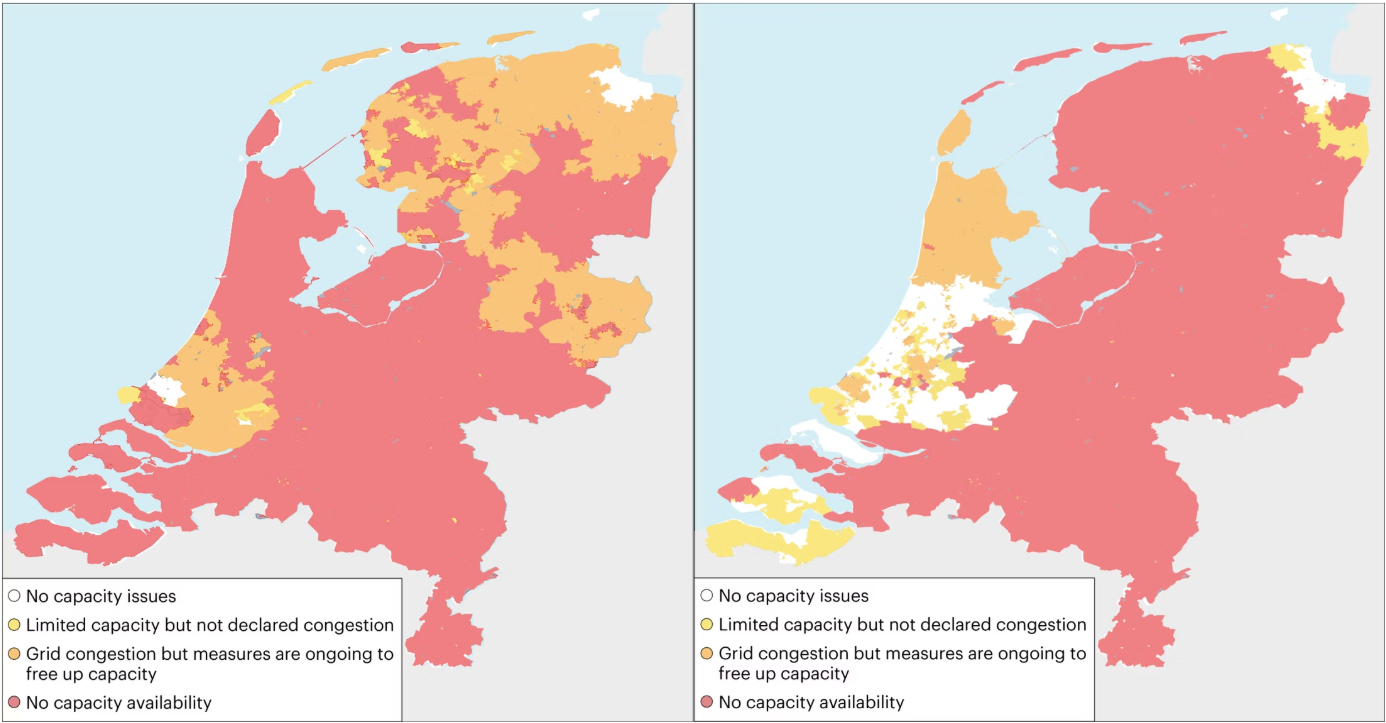
The response, Congestiemanagement, is run by DSOs Liander, Enexis, and Stedin. Flexibility is traded locally to free up capacity in constrained areas. Increasingly, large new connections are required to participate rather than invited to.
The mechanism runs through GOPACS, a shared platform operated by all Dutch grid operators. When a DSO forecasts congestion in a specific area, it publishes a request on GOPACS specifying the time window, region, and capacity needed. Flexible asset owners or aggregators respond with price-volume bids. GOPACS matches bids and compensates the lowest-cost solutions.
Participants can engage through pre-agreed capacity-limiting contracts for predictable revenue, or through intraday redispatch bids for more commercial upside. A large controllable charging load is precisely the kind of asset that qualifies. This makes Dutch fleet depots well-positioned to monetize flexibility they're already managing for operational reasons.
The Netherlands is, in the most uncomfortable way, a preview of where other markets are heading. The congestion is so acute that grid access has become a competitive advantage and flexibility is a business asset. Industrial customers that can demonstrate flexibility have an edge in securing connections at all.
Pioneering since 2021
Dynamic Operating Envelopes (DOEs) are the most technically advanced concept in flexible interconnection globally, and they come from Australia.
The core idea: instead of applying a grid-wide or zone-wide load limit, each site receives its own individualized, real-time import and export envelope calculated from actual local grid conditions. A site in a lightly loaded feeder gets a generous envelope. A site at the end of an already-stressed feeder gets a tighter one. The limits move continuously based on what the grid actually needs at that moment, at that location.
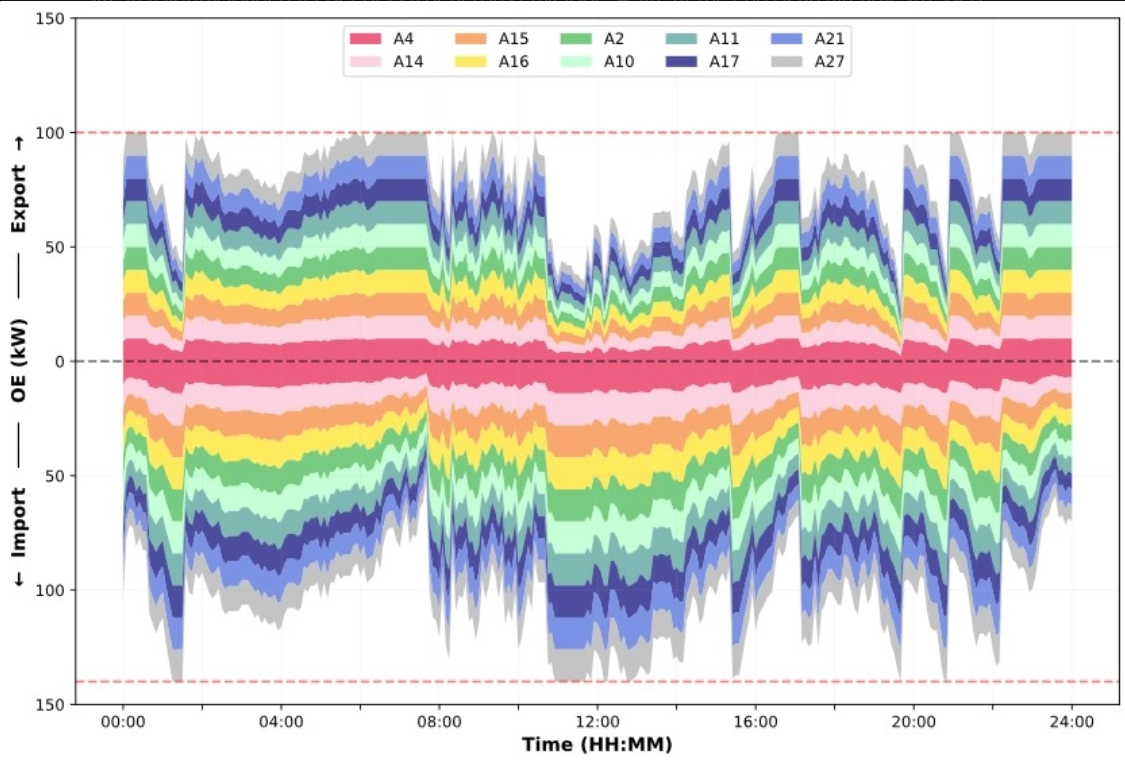
Ausgrid and SA Power Networks have been developing this capability since around 2021. DOEs make the best possible use of available grid capacity without over-constraining assets that have headroom. They create a more accurate signal to customers about where and when flexibility is actually needed. And they enable a future where grid access is dynamically priced and allocated rather than statically permitted.
The limitation is technical complexity. Australia benefits from a relatively young grid management ecosystem that made it easier to adopt ambitious technical approaches. However, implementing DOEs at scale requires real-time data pipelines, advanced grid modeling, and software infrastructure that most utilities don't yet have.
DOEs represent the logical endpoint of what FlexConnect is doing today. Understanding them is understanding where this industry is going.
Necessity and technical ambition, respectively, pushed them further faster. The Netherlands had no choice but to build sophisticated local flexibility markets when connections became unavailable. Australia had the institutional appetite to pursue individualized, real-time grid management when others were still thinking in aggregate curtailment blocks. The US, Germany, and UK are operating serious programs. But at a lower level of sophistication.
All five programs differ greatly in mechanism, signal timing, protocols and value.

However, several design elements appear consistently in leading programs. Here's what works well:
Clear technical protocols. The programs that work have defined how the utility talks to the customer's equipment. IEEE 2030.5 in the US, specific communication requirements in Germany.
Real consequences for non-compliance. Flexibility programs with no teeth become optional. FlexConnect's curtailment risk, Germany's mandatory participation, the Netherlands' access implications: these create genuine incentive to comply.
Predictability for customers. Fleet operators, in particular, can't run charging operations on undefined rules. The programs that gain commercial traction are those with clear rules about how limits are set, how much notice is given, and what happens when they change.
Compensation or access value. Whether through reduced grid fees (Germany) or faster connections (US, UK), or access that isn't otherwise available (Netherlands), customers participate when there's something in it for them.
Voluntary programs without anchor demand. Flexibility programs that rely entirely on voluntary participation struggle to build the liquidity they need to function. Without a critical mass of participating assets, grid operators can't rely on the mechanism.
Protocol fragmentation. The US is the clearest example: each utility designing its own communication requirements and compliance framework means a fleet operator spanning multiple territories faces a different technical and legal regime at each depot. This is a real barrier to scaling commercial fleet electrification, and it will take industry standardization to resolve.
One-size-fits-all curtailment. Flat curtailment applied across an entire zone ignores the reality that grid capacity varies feeder by feeder, transformer by transformer. Australia's DOE approach is more complex, but it's more accurate. And accuracy matters when you're trying to make the most of existing infrastructure.
Ampcontrol is an energy and EV fleet charging platform that is an approved PG&E FlexConnect vendor, certified for IEEE 2030.5 CSIP and designed to operate under dynamic grid programs such as §14a EnWG, ANM, Congestiemanagement or DOEs.
.jpg)
Ampcontrol is a cloud-based software that seamlessly connects to charging networks, vehicles, fleet systems, and other software systems. No hardware needed, just a one-time integration.