Subscribe & get the latest news in your email

By
March 23, 2026

This is Part 2 of a series on managing the full energy stack at fleet depots. Part 1 covered why EV charging, battery storage, and solar need to be managed as one system — not three.
You've decided to build a smarter depot. EV chargers, a battery, rooftop solar. Now comes the key question:
How do you actually connect all of this? That's where most depot projects get complicated.
EV chargers, battery energy storage systems (BESS), and solar inverters were built by different industries with different communication standards. They don't natively talk to each other. Before you can manage them as one system, you need to understand what each one speaks.
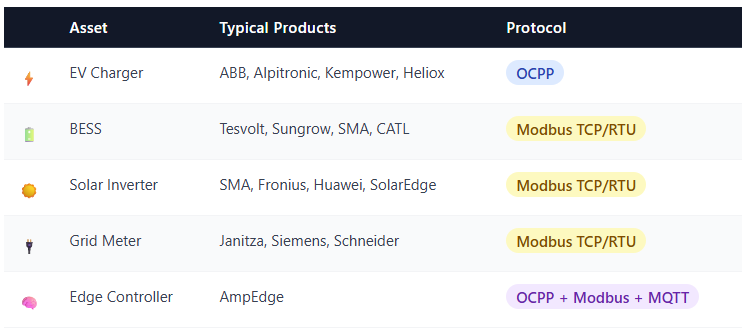
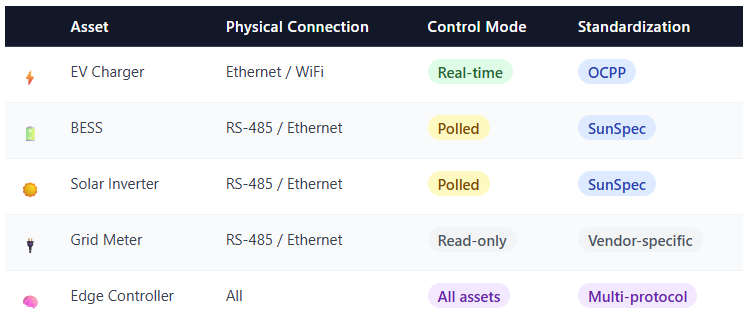
OCPP is the standard for EV chargers. Chargers maintain a persistent connection to a (local or cloud) backend and accept real-time commands for authorization, smart charging, and remote control. If you're buying commercial chargers today, they support OCPP.
Modbus TCP/RTU is how most BESS and solar inverters communicate. It's the industrial automation standard. Reliable and entirely local. Modbus doesn't reach the internet on its own. Something on-site has to read it.
Most BESS and inverter vendors support SunSpec on top of Modbus. A standardized register map that makes multi-vendor integration significantly less painful.
MQTT is the modern alternative gaining ground in batteries and edge-to-cloud communication. Where Modbus polls, MQTT pushes. It's lightweight, low-latency, and increasingly common in newer hardware.
None of these protocols talk to each other by default. You need something on-site. An edge controller that reads Modbus from the battery and inverter, manages chargers via OCPP, handles MQTT where applicable, and maintains a connection to the cloud platform.
The AmpEdge is the translation layer that makes BESS integration possible without a custom engineering project for every site.
Sebastian Föhst, Principal Solutions Engineer at Ampcontrol
The AmpEdge sits at the power cabinet, speaks all three protocols, controls all assets and feeds a unified data stream to the Ampcontrol cloud platform. Charger management, energy management, and fleet intelligence all operate on a single shared view of the site.
Getting the protocols right is only half the job. Here's what real depot deployments teach you about physical connectivity.
On a large logistics site, assets can be >500 meters apart. Typically dispensers are spread across the yard, BESS is near the transformer, solar inverters at the roof connection. If the distances are too long for ethernet or RS-485: run fiber (or at least empty pipes for future extension) to a central switch at the power cabinet. It saves a lot of pain on retrofit or the need of more complex VPN solutions.
Our managed VPN services enable connecting solar, battery and chargers across large depots via a secure tunnel - even if no ethernet or fiber is available.
Dr.-Ing. Jonas Schlund, CPO at Ampcontrol
Large operators have high security requirements. Often operational technology (OT - chargers, batteries, inverters) needs its own isolated network segment, completely separate from the corporate LAN. Even if strict IT/OT separation is not required, using an Ampcontrol managed network can speed up the time to go live. No corporate network involvement, no IT policy changes required.
Many sites depend on cellular SIM cards for cloud connectivity. We recommend using redundant SIMs from different providers with automatic network switching. And critically: if connectivity drops, the local controller needs to keeps running locally: vehicles charge on schedule, the battery keeps operating and nothing waits for a cloud instruction.
A typical fleet depot looks like this:
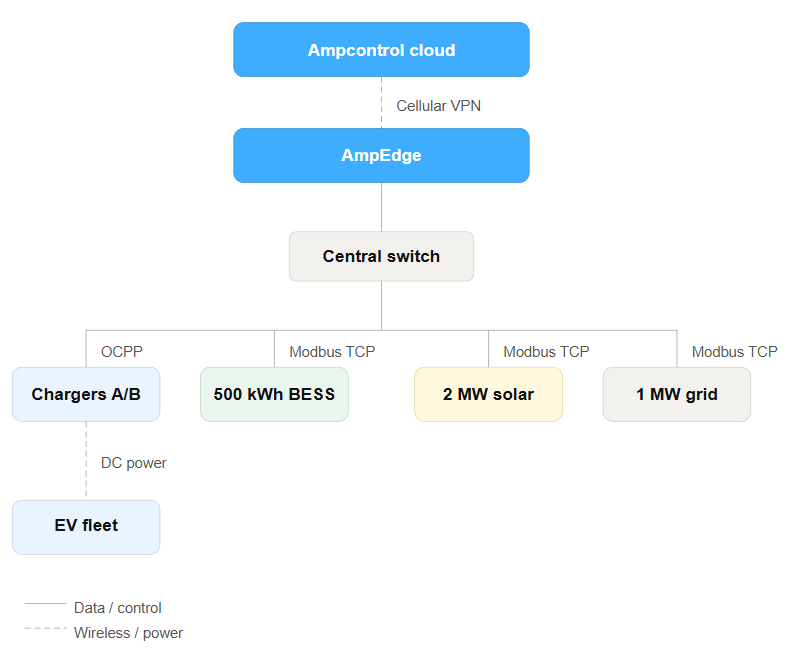
At any given moment, Ampcontrol sees:
It optimizes across all of it. In real time. That's what integrated actually means.
This is part of a series on how Ampcontrol manages the full energy stack at fleet depots. Nextup we'll explain what specific energy optimization use cases these integrations enable and how to make it work even in fully islanded microgrids.
Part 1: Why Your Fleet Depot Needs One Platform for EV Charging, Battery & Solar
Part 2: Networking 101: How to connect battery storage, solar and EV charging
Part 3: [Coming soon] Battery and solar at fleet depots: self-consumption, peak shaving, and EV boosting explained
Part 4: [Coming soon] Islanded microgrids: droop control, grid-forming inverters, black start and frequency regulation explained
.jpg)
Ampcontrol is a cloud-based software that seamlessly connects to charging networks, vehicles, fleet systems, and other software systems. No hardware needed, just a one-time integration.