Subscribe & get the latest news in your email

By
January 8, 2026
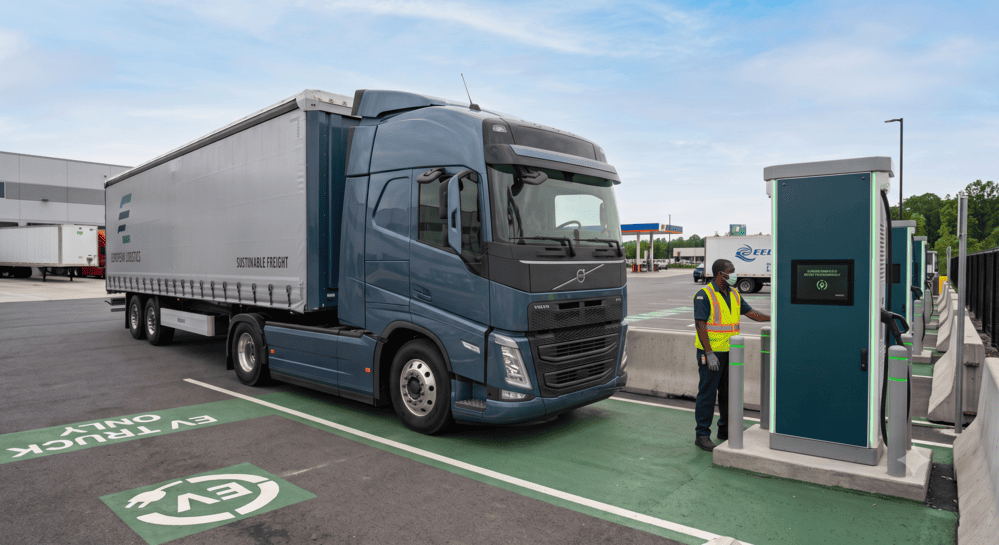
Electric vehicle adoption is accelerating fast, and nowhere is the impact more visible than at industrial sites, logistics hubs, and fleet depots. Installing chargers is often straightforward compared to what comes next: ensuring that the entire site remains reliable while power demand becomes less predictable and dramatically more concentrated.
For many operators, the real challenge isn’t charging itself—it’s the grid. Distribution infrastructure in many regions was never built for multi-megawatt charging loads, and utilities are increasingly forced to manage congestion, voltage fluctuations, and limited capacity. That’s why “grid stability” is becoming a critical topic for every company electrifying fleets, building depots, or running microgrids.
Grid stability is not just a utility responsibility anymore. It’s becoming a site-level operational requirement.
Traditional energy systems were designed around predictable loads. EV charging changes this assumption completely. A depot can go from a moderate baseline to several megawatts of demand in minutes—especially when multiple trucks arrive simultaneously and need to charge before the next shift.
At the same time, utilities face rising load from electrification in general, long lead times for upgrades, and increasing grid volatility. The result is a new kind of tension: electrified sites need more power quickly, while utilities are increasingly cautious about granting that capacity permanently.
This is where grid stability becomes essential. If a site draws too much power too quickly, it can trigger voltage drops, overload transformers, or trip protective equipment. Even when a site stays technically within its limit, rapid load changes can still cause instability. The solution is no longer only infrastructure—it’s control.
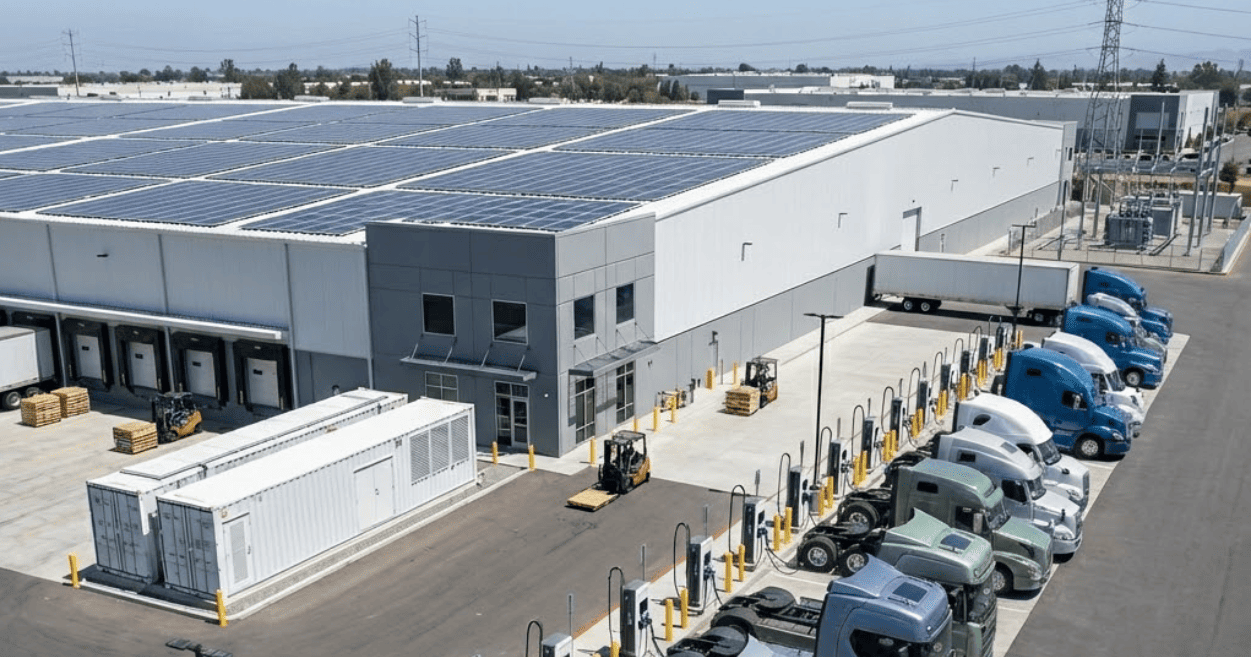
One of the most effective approaches to maintaining stability while scaling power is the use of microgrids. Many companies are now installing battery energy storage systems, often combined with solar, specifically to overcome grid constraints.
A common scenario looks like this: a distribution center has an existing grid connection of 2 MW, but new equipment—such as additional cooling, automation, or EV charging—requires an additional 1 MW during peak periods. In a perfect world, the utility upgrades the connection quickly. In reality, that upgrade might take months or years.
In these cases, onsite storage and solar can act as an “expansion layer” that provides the missing power when it matters most. The site can remain within its 2 MW limit most of the day and use the battery and solar generation to cover the short windows when demand rises to 3 MW.
That’s the key point: most sites don’t need their maximum power continuously. What they need is the ability to reliably supply high peak power for limited periods—often around shift changes, high-throughput windows, or charging peaks.
However, installing batteries and solar is only half the equation. The other half is an energy management system that can coordinate these assets intelligently. It must control the battery and solar in a way that ensures peak power is available when needed, while also protecting the site from overloads and ensuring smooth operation. That requires real-time communication with energy meters, chargers, and assets, plus a high level of reliability. In this world, energy management cannot be “best effort.” It has to behave like industrial control software.
In some countries, microgrids include not only solar and batteries but also fuel-based generation. In Germany, for example, many industrial sites operate combined heat and power units known as BHKW. These plants can produce significant power and may play a larger role in grid stability in the future.
From a long-term perspective, the opportunity is clear: integrate EV charging, battery storage, solar generation, and onsite dispatchable generation into a unified operational layer. Done well, this turns the site from a passive grid customer into an actively managed energy system. It can reduce peak demand, buffer volatility, provide redundancy, and help keep operations stable even during grid constraints.
While microgrids help sites operate within fixed constraints, utilities are simultaneously changing how they offer power connections. Historically, grid interconnection followed a simple model: the customer requests a maximum power level, and the utility either approves it (possibly after upgrades) or denies it. In many regions, however, utilities are no longer able—or willing—to give a clear “yes” or “no.”
Instead, they are introducing a third option: flexible interconnection.
With flexible interconnection, a site receives a guaranteed base capacity—say 2 MW—but may also receive additional capacity that is variable. The utility has the right to reduce or remove that extra power at any time, depending on congestion elsewhere in the distribution grid. The customer gets faster access to capacity, but they lose certainty. Any day, the available power can change.
This model is already being used in California under the FlexConnect program, and similar approaches are emerging in parts of Europe. For operators, flexible interconnection means one thing: you can no longer run your site assuming your maximum capacity will always be available. You need systems that can dynamically adjust charging schedules, battery dispatch, and site loads based on real-time constraints.
That makes energy management and control even more important—not as a cost optimization tool, but as a stability and compliance requirement.
In addition to flexible interconnection, many regions also require large generation and storage systems to install certified controllers or onsite interfaces that allow utilities to intervene during emergencies.
These systems, often implemented through RTUs (remote terminal units) or certified grid-interface controllers, are designed for situations where the utility is facing immediate grid stability risks. In those moments, the grid operator may curtail generation or limit battery discharge in seconds, without manual site approval.
A good example is Germany’s requirement for certified controllers like the EZA-Regler and related rules that apply to generation and storage. While this resembles demand response in concept, the operational structure is different. Demand response typically works through contractual participation and may rely on cloud-based communication protocols like OpenADR. Utility controllers, by contrast, are specifically designed for rapid, automated intervention under grid-code frameworks.
The important distinction is that with utility controllers, the site can operate at full capacity under normal conditions—but must be prepared for instant curtailment under emergency situations. Once the emergency ends, control returns to the site.
For electrified depots and microgrids, this is becoming part of the standard grid integration landscape.
Grid stability depends on visibility. Without high-quality data and real-time telemetry, even well-designed systems can fail. The most critical metrics start with total site load and peak demand patterns, because these determine whether the site is approaching its grid limit or risking protective trips.
Battery storage adds a second layer: operators must monitor state of charge, dispatch behavior, and reserve availability. A battery that is empty during peak hours provides no stability. A battery that discharges too aggressively early in the day can leave the site vulnerable later.
Solar adds another layer of complexity because generation fluctuates with weather and daylight. Without forecasting, operators can unintentionally plan around energy that won’t be there. And chargers add further dynamics, because charging load is not only large, it is also variable and often tied to operational constraints such as departure times and route requirements.
If the site operates under flexible interconnection, monitoring must also include real-time import limits, curtailment events, and compliance logs. Finally, power quality becomes increasingly important as charger power electronics and inverter-based systems scale. Voltage, frequency, and harmonics can become limiting factors even when total power stays within limits.
A stable electrified site requires more than dashboards and reports. It requires automated control.
A modern energy management system must be able to coordinate charging and dispatch across all energy assets, enforce hard import limits, protect peak power availability, and respond dynamically to grid constraints. It should also include reliable fallback behavior when communications fail—because in industrial energy operations, failure modes are as important as normal operation.
The best systems operate with short control cycles, high reliability, and integration to both onsite devices and utility signals. In flexible interconnection environments, they should be able to reshape load in response to changing limits. In regulated environments, they should support certified interfaces and fast curtailment behavior.
In other words: the EMS becomes the site’s real-time stability engine.
A key feature we rely on heavily is Ampcontrol’s load management functionalities, which we use to control the costs of recharging our fleet.
Hart Uhl, Senior Charging Operations Manager at Revel
As electrification accelerates, grid stability is becoming a shared responsibility. Utilities are evolving interconnection models and stability requirements, while site operators are deploying batteries, solar, microgrids, and advanced energy management platforms to keep operations running smoothly.
The winners won’t be the ones who install the most chargers fastest. The winners will be the sites that build energy systems capable of real-time monitoring, control, and adaptation—because that is what reliable electrification requires.
Grid stability isn’t a nice-to-have anymore. It’s the foundation.

Ampcontrol is a cloud-based software that seamlessly connects to charging networks, vehicles, fleet systems, and other software systems. No hardware needed, just a one-time integration.