Subscribe & get the latest news in your email

Door
May 19, 2026

If you lead sustainability or ESG reporting at a large shipper, ISO 14083 is the standard defining what "good" looks like for transport emissions data. It was published in March 2023, and it's already the methodological backbone of the EU's CountEmissionsEU initiative. Most of the explainers treat it as a logistics or fleet topic. But for shippers, it's a procurement and data-quality issue and electric vehicles are where the standard gets trickiest.
This post walks through what ISO 14083 actually requires, why electric fleets and charging depots create a new layer of complexity, and the specific questions you should be asking your carriers when they report EV emissions back to you.
ISO 14083:2023, Greenhouse gases — Quantification and reporting of greenhouse gas emissions arising from transport chain operations, is the first global standard for calculating GHG emissions across full transport chains.
Three things make it different from the carbon accounting you're already familiar with:
Who it applies to? The standard applies to shippers, carriers, logistics service providers, transport operators, and hub operators that need to quantify or report transport emissions.
Who's effectively pulled into scope? Anyone in the supply chain whose customers are reporting under CSRD, CountEmissionsEU, the GLEC Framework, or SBTi-aligned targets. If you're a Fortune 500 shipper, or a carrier or vendor serving one, you are affected.
For a carrier running diesel trucks, ISO 14083 reporting is reasonably mature. Fuel volumes are metered, emission factors are well-established.
For a carrier running electric trucks, vans, or buses, the picture is messier, and the messiness has direct consequences for any shipper relying on their data. Under ISO 14083, an EV's operational ("tank-to-wheel") emissions are zero. All of the carbon impact lives in the energy provision category — the emissions associated with generating and delivering the electricity that ends up in the battery.
To calculate that number correctly, the carrier needs three things you should be asking about:
A carrier reporting "our electric fleet is zero emissions" is not ISO 14083-compliant. A carrier reporting a single national grid average across an entire annual fleet is technically allowed but is the lowest-quality data tier the standard recognizes.
Solar and batteries only make a depot low-carbon if the data can prove it.
Dr.-Ing. Jonas Schlund, CPO at Ampcontrol
The gap between those answers and a properly built bottom-up calculation can be significant. An analysis of 2024 ElectricityMaps data across 300 grid zones found hourly carbon intensity ranging from 0 to 1,158 gCO₂/kWh and the variance is widest in renewable-heavy grids. If your carrier reports a single average, you're losing visibility into both the upside and the variance.
This is the section that most ISO 14083 explainers skip, and it's the one that matters most if any of your carriers operate their own charging depots or charge at shipper-owned warehouse.
A modern fleet depot is rarely a simple "grid in, charger out" facility. It's a small energy system: utility connection, on-site solar PV, often battery energy storage (BESS), sometimes V2G-capable vehicles, all sitting behind a single meter. Every kilowatt-hour delivered to a truck might come from the grid, from solar generated an hour ago, from solar generated yesterday and stored in a battery, or from some blend of all three.
ISO 14083 doesn't fully resolve how to allocate emissions in this kind of behind-the-meter setup. A 2024 Smart Freight Centre whitepaper specifically called out three open issues:
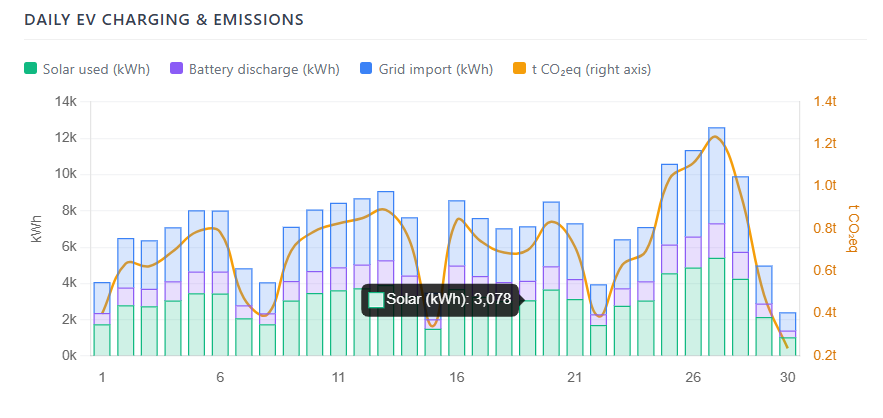
For a sustainability lead at a shipper, the practical implication is simple: a depot with solar and batteries is not automatically a low-carbon depot in your books. It depends entirely on how the underlying electricity flows are measured, allocated, and documented.
If you're going to use carrier-reported emissions or charging data from your own warehouses inside a CSRD disclosure, a CDP submission, or an SBTi-aligned reduction target, the data needs to survive audit. Here are the questions that separate a serious ISO 14083 calculation from a marketing claim:
1. Are you reporting both operational and energy-provision emissions?
Good answer: yes, with well-to-tank explicitly broken out.
Red flag: a single number labeled "EV emissions" with no decomposition.
2. What is the source and time-resolution of your electricity emission factors?
Good answer: location-specific factors, ideally hourly or minimum monthly, from a recognized source (national grid operators, AIB, EPA eGRID, IEA).
Red flag: a single annual national average applied to every kWh.
3. How do you measure kWh delivered to the vehicle vs. kWh drawn from the grid?
Good answer: charger-level session data or telematics, with charging infrastructure losses explicitly modelled.
Red flag: utility bills divided by fleet size.
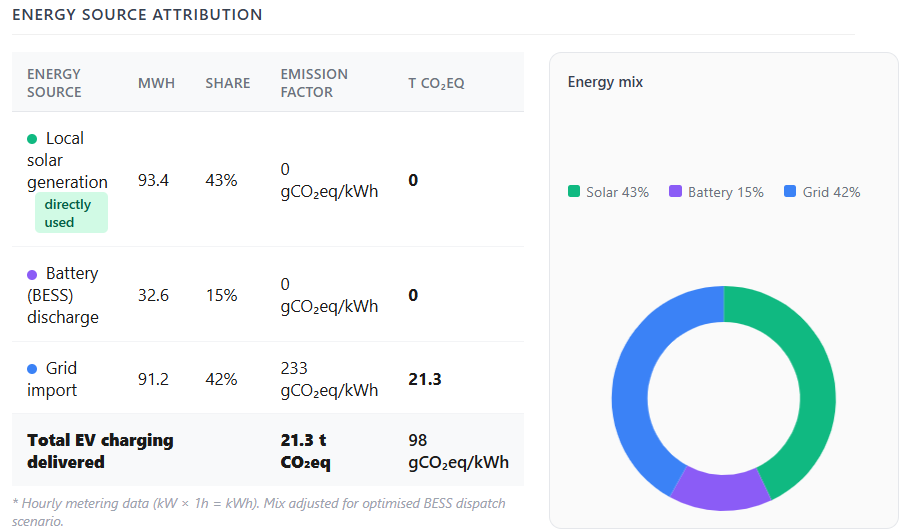
4. How is on-site solar and battery storage allocated?
Good answer: a transparent methodology, ideally backed by sub-meter data showing the timestamp and source of each kWh entering a vehicle.
Red flag: "we have solar so we count it as zero."
5. Are you using market-based instruments? If so, are they bundled or unbundled, and where were they sourced?
Good answer: clear disclosure of which RECs, GOs, or PPAs are being claimed, with geographic and temporal alignment to the charging activity.
Red flag: vague references to "100% renewable" with no instrument-level detail.
6. Can you provide the data at TCE level, not just an annual fleet roll-up?
Good answer: emissions allocated per shipment, route, or transport chain element.
Red flag: only fleet-wide totals.
ISO 14083 is currently a voluntary standard, but the regulatory gravity is unmistakable. For sustainability leads at large shippers, the takeaway is that the bar for transport emissions data is rising fast — and EV-related data is rising fastest, because the methodology is least mature.
The carriers and depot operators who can produce granular, time-resolved, source-attributed electricity data will be the ones whose numbers survive scrutiny. The ones still reporting annual averages will increasingly look like a reporting risk, not a sustainability win.
The good news is that the technical infrastructure to do this well already exists. The harder problem is making it a procurement requirement before the audit finds it for you.
.jpg)
Ampcontrol is een cloudgebaseerde software die naadloos aansluit op laadnetwerken, voertuigen, wagenparksystemen en andere softwaresystemen. Geen hardware nodig, slechts een eenmalige integratie.